
schenn-kadri-deadline-bug

Slow news day?

Realistically no, Friday, 2026 NHL Trade Deadline day, will still be the newsiest day on the NHL calendar this season. But this deadline day paled in comparison to previous years.

There were 20 trades involving 33 players completed Friday, the slowest amount of activity on an NHL trade deadline day since April 12, 2021, when there were 17 deals involving 26 players. 

Deadline day activity in the past four seasons averaged 22 trades and 36.75 players moved.

There was a late push just before 3 p.m. ET with trades also trickling in two hours after, which happens every year on deadline day, but this deadline day was different.

“I wouldn’t say the volume of calls in and out was any more or less than any other year,” Chicago Blackhawks general manager Kyle Davidson said, “but around the League, it maybe seemed a little more quiet than normal.”

It might be the new normal.

“I thought that it would play out that exact same way that it played out,” Utah Mammoth general manager Bill Armstrong said.

There were still some significant trades.

The New York Islanders acquired center Brayden Schenn from the St. Louis Blues and the Detroit Red Wings got defenseman Justin Faulk from the Blues, both bolstering their chances of reaching the Stanley Cup Playoffs in a wide open Eastern Conference.

The Colorado Avalanche beat the deadline buzzer to get center Nazem Kadri from the Calgary Flames, and in the move nobody seemed to see coming, longtime Washington Capitals defenseman John Carlson was traded to the Anaheim Ducks in the wee hours of the morning.

The NHL Now crew discuss the Nazem Kadri and John Carlson trades

But many players did not move despite having their names discussed as potential trade candidates in the days leading up to Friday, including two that were even scratched for roster management purposes.

Vincent Trocheck is still a center for the New York Rangers. Oliver Ekman-Larsson is still a defenseman on the Toronto Maple Leafs. Both did not play in New York’s 6-2 win at Madison Square Garden on Thursday because of roster management purposes.

The Blues kept forwards Robert Thomas and Jordan Kyrou, defenseman Colton Parayko, and goalie Jordan Binnington

Forwards Ryan O'Reilly, Steven Stamkos, Jonathan Marchessault and Erik Haula are still with the Nashville Predators.

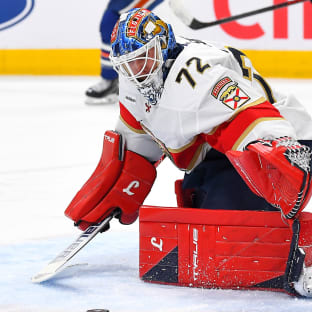
Sergei Bobrovsky is still with the Florida Panthers, and reportedly working on a contract extension to stay there. The 37-year-old goalie is in the last year of a seven-year contract.

The Vancouver Canucks didn’t trade center Elias Pettersson. The Calgary Flames held onto forward Blake Coleman. The Philadelphia Flyers kept defenseman Rasmus Ristolainen.

“The salary cap, I think, affected every team at the deadline here, meaning teams could keep their players or had the option of keeping their players,” Detroit general manager Steve Yzerman said. “A lot more teams have more cap space, which gives them more flexibility.”

NHL Tonight on the Capitals trading John Carlson to the Ducks

The cap used to be the deterrent to keeping players because it was flat coming out of the COVID-19 pandemic. But the NHL has entered an era of cap growth with it up to $95.5 million this season from $88.0 million last season, and going up to $104 million next season.

With more money in the system, teams aren’t under the same cap constraints, which removes the pressure for them to trade players for below what they feel their value is on the market.

For example, Trocheck is signed for three more seasons at a reasonable $5.625 million cap charge. He’s a 32-year-old, top-tier No. 2 center. The Rangers did not trade him now because they had an asking price and they did not bend from it.

The Predators have the same situation with O’Reilly, Stamkos and Marchessault, as the Blues do with Thomas, Kyrou, Parayko and Binnington, and the Maple Leafs with Ekman-Larsson.

“I think we got fairly close, but until it's done, it's not done,” Predators general manager Barry Trotz said, speaking specifically of O’Reilly. “There was a lot of interest in that. We had a certain value. If you hit your value, then that was a go. I think you saw that around the League. I think rumors of other players that Ryan was in the same category, I think only one of them really went. A couple of the ones, they had the same value. If they give us this value, we'll move the player. If not, then we're happy. I don't have to move Ryan O'Reilly. He has a lot of value for us, so that was just the thought process. We stuck to it. We stayed disciplined there."

Playing into that is that this was not a trade market flush with rentals. The three most well-known players moved Friday – Kadri, Schenn and Faulk -- all have term left on their deals.

Players with term are viewed as being more valuable than rentals because teams can grow with them. And with selling teams holding firm on their asking prices, it limits the trade market entirely unless the buying team is willing to go further than it initially planned to go.

“Sometimes other clubs make that easy on you because of the simple fact of their ask and what they're doing, and it would deplete your entire organization and you're not going to do that,” Armstrong said. “Sometimes the ask for some of the elite players that were available, it wasn't even questioned that we do that as an organization.” 

The cap growth has also allowed teams to re-sign their own players more often than in previous years. That’s a big reason why this was not a rental market.

All of the top players on the pending unrestricted free agent list at the start of the season already have new contracts for next season, including Connor McDavid, Jack Eichel, Artemi Panarin, Kirill Kaprizov, Martin Necas, Adrian Kempe and Kyle Connor

The top pending UFAs now are Alex Tuch with the Buffalo Sabres, Nick Schmaltz with the Mammoth and Bobrovsky with the Panthers.

Buffalo and Utah are in the thick of the playoff races, so Tuch and Schmaltz weren’t going anywhere. The Panthers want to re-sign Bobrovsky.

“You saw that this year, coming down the stretch, everybody got re-signed and there wasn't a lot of people or inventory into the market,” Armstrong said. “I think it's kind of what we're going to see for the next few years.”

Changes in the collective bargaining agreement also played a role in a quieter deadline day.

Starting this year, teams are not permitted to make double salary cap retention trades.

It used to be that the trading team would agree to retain cap on a player and the acquiring team would include a third team in the deal that would help broker it by retaining another portion. That eased the cap burden on the acquiring team and opened the market for more moves.

Now there has to be a 75-day separation between retentions on the same player.

“Teams would have made more moves if prices were split in half,” New Jersey Devils general manager Tom Fitzgerald said. “I think it was obvious by looking at the past and how many double retentions there have been versus this year. … The double retention has been a staple for this day forever, and when you take that out, it's probably why you saw as, I don't want to say little trades, but not as many as the past.”

Winnipeg Jets GM Kevin Cheveldayoff called it, “an interesting dynamic in the League right now.”

It all played a role in a quieter deadline day, and we all might have to get used to it as being the new normal.

NHL.com columnist Nicholas J. Cotsonika, senior draft writer Mike G. Morreale, deputy managing editor Adam Kimelman, staff writer Tracey Myers, and independent correspondents Darrin Bauming and Robby Stanley contributed to this story.

Related Content