Bennett Stubbs badge

TORONTO -- By the time the World Cup of Hockey 2016 is in the history books, Bruce Bennett and his team of photographers will have shot more than a quarter of a million images.
That's a few more than you took on your summer vacation.
The photos will record every important moment of this tournament, as well as many scenes off the beaten path -- emotional and poignant, whimsical, even a little goofy.

Bennett and his team are creating a living history of this event. The scope of their work and the coordination required to pull it all off, under the separate umbrellas of the international agency Getty Images and that of the World Cup of Hockey, are staggering.
"The thing for us is that this is such a short tournament," Bennett said during a short break Saturday afternoon, tucked away in a corner of the second-floor Air Canada Centre suite serving as the hub of his operation. "We're tasked with getting images for Getty Images as well as for the World Cup of Hockey. I'm supervising two crews that are working independently, and the images of each of the two crews need to stand as a collection on their own. But pushed together, they need to be a whole view of the entire event."

Getty studio

The roster of people involved? Bennett chuckles when he tries to conduct an inventory.
"We've had a problem with scheduling, with photographers handling baseball and other events around, so we've moved in and out 16 different people throughout this tournament," he said. "But for each game we have a crew of seven or eight photographers, editors, and the runners who help out by moving remote cameras, changing digital cards and things like that."
This isn't Bennett's first visit to a hockey arena. The native New Yorker has a colossal body of work, having begun in hockey photography as a naïve (his word) 18-year-old in 1973-74, shooting from the balcony of Madison Square Garden and selling images for $4 each to Ken McKenzie, publisher of The Hockey News, then based in Montreal.
"They were really bad photos," Bennett said with a laugh when we talked previously about his start in the business. "But Ken asked me in a letter, which I still have: 'Can you get into the games on your own, or do you need a press pass?' I opted for the press pass."

Sedin puck

Countless press passes and more than 2 million photos later, Bennett is still shooting, arriving at NHL games using his two cameras, a fish-eye lens and a 28-300-millimeter zoom to take roughly 1,000 images per game.
Last fall, with The Hockey News, Bennett published "Hockey's Greatest Photos: The Bruce Bennett Collection," and its companion French-language edition. Modest about his work, he winces at the title, which was his publisher's idea, not his own.
Bennett photographed the first of his 36 Stanley Cup Finals in 1976, when the Montreal Canadiens stunned the Philadelphia Flyers in four straight. His résumé includes 27 NHL All-Star games, probably 400 international games, including four Winter Olympics, and now well in excess of 5,000 NHL games. Many of his photos are among the most iconic in the history of the game.
After selling his enormous archive to Getty Images in 2004, Bennett signed on with the company as a staff photographer. His title now is Director of Photography, Hockey Imagery, but in his heart he's a photographer, first and foremost.

Bennett through glass

Bennett began planning this World Cup adventure last April, immediately after the end of the Toronto Maple Leafs season, when the NHL brought him to Toronto to study Air Canada Centre lighting tests that were being done.
Days before the tournament got underway, he was waxing poetic on social media about four 500,000-watt LED lighting banks that had been pulled into the arena rafters. These panels are not exactly the bulbs that were bolted to the glass of Maple Leaf Gardens by Original Six photo pioneer Harold Barkley, or the strobes later installed in the roof of the Montreal Forum by Denis Brodeur.
Bennett shakes his head at the power of the four units his crew is using here, describing it "as a ridiculous number I still can't wrap my head around.
"Apparently each of the four units would provide power for 1,000 homes or something," he said. "So if everyone's lights dim in Toronto during the games, you'll know it's just so the photographers will have great light in the arena."
The LED banks supplement the available light in Air Canada Centre, providing a clean, constant, strobe-free light source.

Bennett wch overview

"With strobes, you can shoot one frame only every three seconds," Bennett said. "With the available light and with these LED boards, we can shoot 10 or 12 frames a second, so we know that each individual moment is captured properly."
For every World Cup game, each photographer is running multiple remote-triggered cameras, each remote shooting 1,000 to 1,500 images per game. Roughly 15,000 photos are taken per game, edited by the photographers themselves during play stoppages and by a team of editors in Getty's arena suite.
"I'm sitting at rinkside with a laptop, and at play stoppages I'm editing my own material," Bennett said. "When we get into the semifinals and finals, I'll have an extra editor here and an offsite editor. The editors here, and they're under horrible pressure, will move images through the Internet to someone who's sitting on Long Island [N.Y.], watching the game, filing images to our website from home."
Bennett has taken so many remarkable photos in just the preliminary round that he's hard-pressed to choose one favorite.
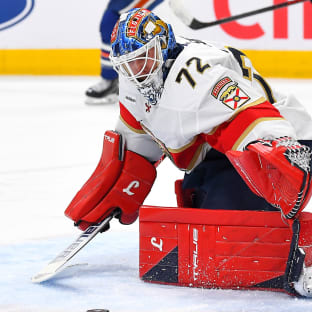
"It's all a blur," he said. "In a tournament like this, which is sort of like the Olympics, the net-cam images (from remote cameras installed in both nets) come up big. There are so many goals, so many great stretches by goalies trying to reach the puck. A lot of those are special.
"But maybe the image that stands out in my mind from the last week is of Team Russia's Evgeny Kuznetsov (which he took Sept. 19), celebrating a goal against Team North America. We always look for odd things with reflections off the glass, shadows, things that lend themselves to something different.

Kuznetsov glass shot

"You're shooting the game, looking through the viewfinder, and as soon as there's a play stoppage you take a look at the camera and see if you got anything so you can tag the images. From the remote cameras, the one in the rafters shooting straight down, and the net-cam, it's always a thrill. It's like Christmas Day; you open up that digital card, having visualized what the action looks like from that angle. You've been holding a camera button down at 12 frames per second and you really don't know until you look at those digital cards whether you had anything that was any good."
Sifting through the World Cup catalogue of Bennett and his team, there's a great deal that has been good, with gusts to magnificent, even historic. From team photos and victory celebrations to a shot of a fan having caught a stray puck in a beer cup, they've shot it all.
Bennett has been In Toronto since Sept. 13 and will stay until tournament's end, then immediately shoot three NHL preseason games in the New York area. Only then will he take a week off to plan and prepare for the marathon NHL season Getty Images will cover through to the Stanley Cup Final and beyond, including every special event on and off the ice.
"October is huge for us," Bennett said. "We want to get every new player in their new uniforms as quickly as possible. I've already booked the October schedule. I put my schedule in, then fit everyone else in around me in the New York area, then schedule all the photographers around the country as well to make sure we get the right matchups covered."

Bennett Crosby shot

He said he's looking forward to the week before the NHL season begins "to get my head into it a little bit and study my notes on which players need to be hit early on. Right now I'm also heavily engrossed in the project of shooting all the head shots of the players, making sure they get online correctly.
"I'll be looking at all those images in the next day or two," he added with a laugh, "maybe during play stoppages of the World Cup games."
In an earlier talk, Bennett said: "A golfer will always tell you it's that one shot in a round that brings him back to play the next day. With hockey photography, it's exactly the same thing: You think about the next game and you come back because you never know when you're going to get a stunning shot."
With four, perhaps five World Cup games still to be played, Bennett and his crew will keep shooting, never certain how a game will play out. And that's the beauty of it. Bennett has been doing this long enough to know the perfect photo hasn't yet been taken. It's the pursuit of it that keeps him at the corner glass of hockey rinks, and in the stands, dressing rooms and in the rafters, hoping it's out there somewhere, one press of his shutter away.

Bennett North America action