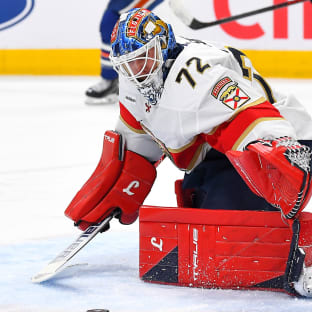

Price switching style before new Canadiens goaltending director arrives
After tweaking game, more adjustments could follow under Burke's tutelage

© Jeff Vinnick/Getty Images
By
Kevin Woodley
NHL.com Independent Correspondent
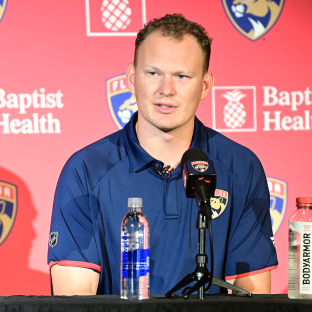
"I'm not going to give you my technical secrets," Price said after stopping 28 of 29 shots in a 2-1 shootout loss at the Vancouver Canucks on Monday.
Price's game has been dissected extensively this season, even more so after Stephane Waite was fired as Canadiens goaltending coach March 2 and retired NHL goalie
Sean Burke
was named goaltending director.
The timing of that change, which came six days after Dominique Ducharme replaced the fired Claude Julien as coach, makes it harder to properly credit any adjustments Price already may have made.
After starting the season 5-4-3 with an .888 save percentage, Price is 3-0-1 in his past four starts and has given up one goal in each, stopping 105 of 109 shots (.963 save percentage).
That stretch includes the game when Waite was fired, a 3-1 win against the Ottawa Senators. For the previous four days, Waite had been working 1-on-1 with Price on playing less aggressively to reduce his movements.
Price more recently has been working with goaltending coach Marco Marciano to keep his hands more out in front. Marciano was promoted from the American Hockey League on an interim basis after Waite was fired.
Things in front of Price appear to have changed too.
Defenseman Shea Weber said Wednesday that Montreal has started to play better defensively. Of the 37 goals Price gave up before the coaching changes, nine were through a screen, and five of those involved teammates affecting Price's vision of the shot release.
The Canadiens (12-7-7) are 3-1-2 in their past six games, in fourth place in the seven-game Scotia North Division; the top four teams will qualify for the Stanley Cup Playoffs.
"The guys are playing solid hockey in front of me and letting me see the puck," Price said.
Burke, who has been in quarantine since March 4 because of COVID-19 protocol, is expected to join Montreal after it returns home from its six-game road trip, which concludes at the Winnipeg Jets on Wednesday.
MTL@OTT: Price stands strong to stone Tkachuk
Whether Burke asks for more changes once he gets on the ice with the Canadiens remains to be seen, but his history as a goalie and goaltending coach suggests at least one change could be coming.
Historically, Burke has the goalies he coaches play deeper in the crease. It was a change he made during his NHL career, which ran from 1987-2007 and featured stops with the New Jersey Devils, Hartford Whalers, Carolina Hurricanes, Vancouver Canucks, Philadelphia Flyers, Florida Panthers, Phoenix Coyotes, Tampa Bay Lightning and Los Angeles Kings.
With the Coyotes, goaltending coach Benoit Allaire, now with the New York Rangers, convinced Burke to play deeper in his crease, much like he did with Henrik Lundqvist years later with the Rangers.
Burke had his best NHL seasons after making Allaire's changes; his top three in terms of save percentage were in his three seasons with the Coyotes from 2000-03.
Burke adopted Allaire's teachings upon becoming Arizona's goaltending coach in 2010, helping revitalize the career of Mike Smith with a philosophy that echoed the deep-in-the-crease style of Lundqvist.
Smith, who played for the Coyotes from 2011-17, is in his second season with the Edmonton Oilers.
"Absolutely, I plagiarized everything," Burke said during the InGoal Radio Podcast earlier in his career. "I took everything I learned from Benoit from a technical side and I put it into my own coaching."
Price typically has played near or outside the edge of his crease. Though attention will focus on where he plays under Burke, the bigger style difference might be how Price gets there.
Waite encouraged some backward flow, with Price starting farther out and retreating to match the speed of rush attacks. The Burke/Allaire approach is for the goalie to start well inside the crease, which reduces the distance to beat east/west lateral plays, and then attack out as needed.
In its simplest terms, it's inside-out movement rather than outside-in.
"Benoit just got me to think about letting the play come to me," Burke said in the same podcast. "The one thing that's never changed about goaltending and never will, is the puck has got to come through you to get into the net and if you're in position, that's as simple as it really gets. You can't chase it. It's going to end up coming right to you at some point and so I started to look at that side of the game a lot differently."
It's more of a tactical change than a technical one, but it's not always an easy one.
Vegas Golden Knights goalie Marc-Andre Fleury went through a similar positioning adjustment in 2013-14 with the Pittsburgh Penguins, but started the change in the summer.
"It's not easy when you see guys in the slot with time to pick corners and stuff, just waiting there," Fleury said at the time. "Sometimes they are going to be able to pick corners, so you think you have to be able to get out there and be aggressive."
The good news, according to San Jose Sharks goalie Devan Dubnyk, is the philosophy isn't anchored in definitive terms of where the goalie plays in the crease. Dubnyk credits a partial season with Burke as his goalie coach in Arizona in 2014-15 with turning around his career.
The rules are more about finding a depth that provides the opportunity to beat any pass to its next position while remaining upright, rather than sliding on the knees. Or, as Allaire tells his goalies, "beat the pass, solve the equation."
"All Burkie told me," Dubnyk said, "was he didn't care where I stood in the crease as long as your feet are set and when a pass comes you can get over on your feet, beat the puck, stop and be set. He didn't care where I was in the crease as long as I was capable of doing that."
How much more Price is asked to change, if at all, to accomplish that goal remains a question, and the difference may be so subtle it would be difficult to detect.
Just don't expect Price to point it out.