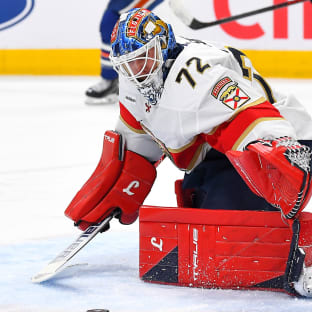
But by the middle of Game 2, those chants had been abandoned. Instead of the Boston Bruins and their goaltender wilting, as they had hoped, Swayman was as strong as ever, his second straight outstanding start bolstering the Bruins just when they needed it.
And though Swayman and the Bruins would allow two goals at the end of a scrambly, prickly third period that included a total of 17 penalties (nine on the Bruins, eight on the Sabres, four of them 10-minute misconducts), they came out ahead 4-2 on Tuesday at KeyBank Center, sending the teams back to TD Garden for Game 3 tied 1-1 in the best-of-7 series.
Much of the credit for that went to their goalie.
“It’s calmness,” defenseman Nikita Zadorov said of what he’s seen from Swayman in the first two games. “It’s super important to see from the goalies. His confidence is great. Like I said, I don’t want to give a lot of compliments to goalies, I don’t like to jinx it, but he’s been awesome.”
Because after what had happened in Game 1 – those three goals in just a 4:34 span in the third period that stunned Boston and gave the Sabres the 4-3 win – the steady presence of a Vezina-level goalie was a salve.
That was especially the case after the way Game 2 started, with pressure from the Sabres, with their speed and their pace ticking up, with Buffalo taking up residence in the offensive zone in a way that seemed sure to be riding the momentum from Game 1.
So how did they flip that?
“There’s a couple reasons,” Bruins coach Marco Sturm said. “You need a good goalie. I think that’s the biggest thing. He kept us pretty calm right away. You could tell by the way he’s in the zone again.”
It wasn’t the last time he would keep them calm.
Not only did Swayman make 34 saves, allowing his only two goals on the 20 shots he saw in the third period onslaught, he had another save too.
It was after those two quick goals, as the four-goal advantage was cut in half, with Bowen Byram scoring at 13:54 and Peyton Krebs at 15:08. That was when, as soon as the puck squirted through and into the net, Swayman stood up.
He made a timeout gesture toward the Boston bench. The Bruins called the timeout.
“I think it was a little bit of a momentum shift,” Swayman said. “I knew we weren’t going to have a TV timeout after the goal call, so it was just for everyone to take a breath. We know that we have a standard to play at and I thought that the momentum shifted a little bit and a ton of kudos to my group for responding extremely well.”
They held them off. They got the win.
There was no question, from the start of the series, that Swayman was going to have to be at his best if the Bruins were going to advance. The Sabres came in with the offensive advantage, with more dangerous threats than were posed by Boston.
But Swayman was coming off a stellar season, in which he had reclaimed his spot among the elite at the position, in which he had prioritized his mental strength, in which he had bolstered his big-game bona fides by leading the United States to its first gold medal at the 2025 IIHF World Championships since 1933 and being selected for Team USA at the 2026 Winter Olympics.